
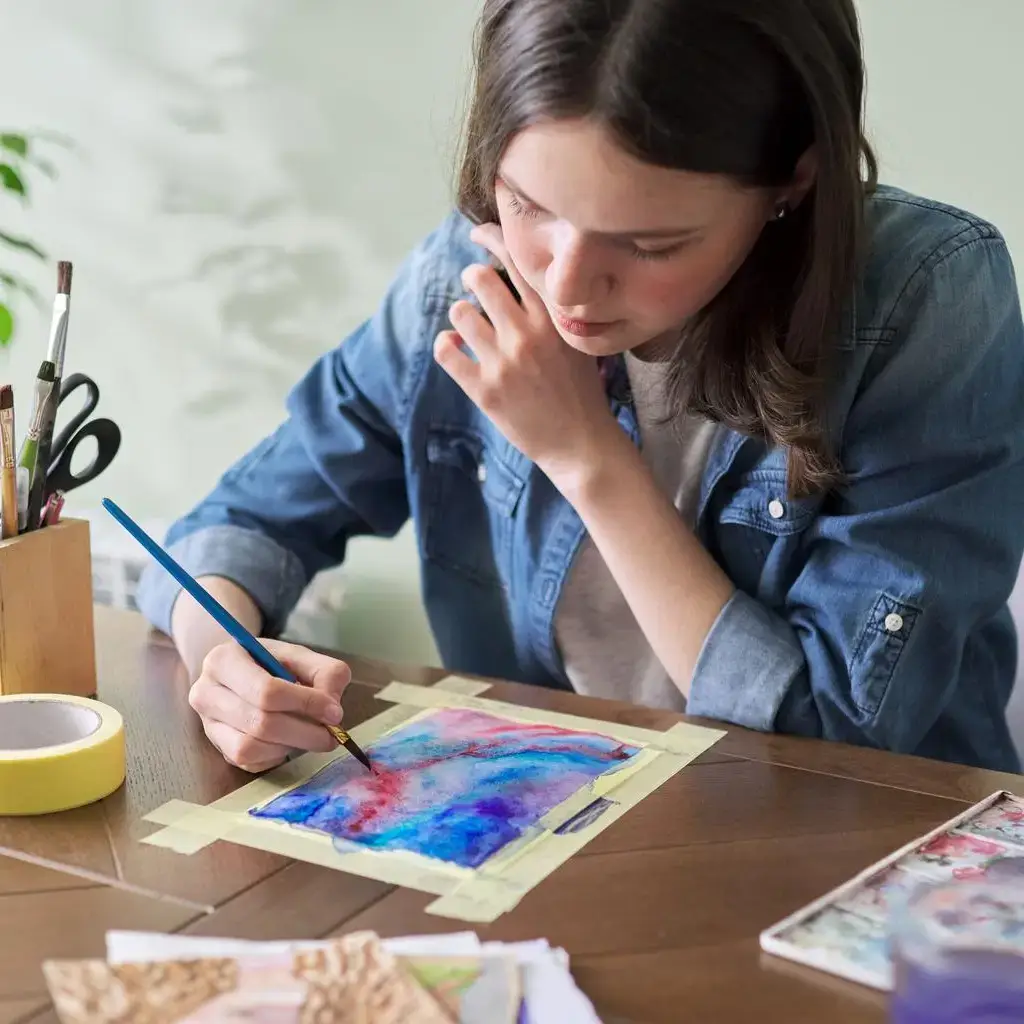
How Creative Work Supports Change
There are four things I see creative work doing, and they tend to build on one another over the course of a process.
- Expression. Making something gives thoughts and feelings a way out that doesn’t depend on finding the right words for them first.
- Externalization. Once an experience takes visible form on the table in front of you, it sits at a slight distance. It becomes something you can look at rather than something you are inside of.
- Reflection and insight. Looking at what has been made, and talking about it, builds awareness of emotional patterns that were difficult to see from within.
- Integration and change. What comes out of that reflection supports emotional regulation and a different relationship to the experience, one that can be carried out of the room and into everyday life.
What It Can Help With
This work can support people dealing with traumatic experiences, grief and loss, identity exploration, difficulties with emotional regulation, life transitions, and relationship challenges.
I lean on it most with people who have been through significant difficulty, particularly trauma, though it isn’t limited to that. It can also support people and families going through demanding medical treatment or hospitalization, including situations where the outcome is uncertain. In my experience, working with materials also tends to have a settling effect on the nervous system, which matters when someone is carrying a lot of activation.
Art Therapy for Adults
For adults, art therapy can offer a reflective space to pause, explore personal experiences, and reconnect with inner resources. It suits people who find that talking alone has stopped opening anything new, and people for whom putting an experience directly into words is still too raw.
Art Therapy for Young People
Adolescence and young adulthood bring changes in identity, relationships, and self-understanding that can be hard to articulate on demand. Art therapy can offer a more accessible and intuitive way to express and understand those experiences, without requiring a young person to explain themselves before they are ready.
Art Therapy for Children
With children, art therapy often integrates elements of play therapy. Children tend to communicate indirectly, through metaphor, images, and storytelling, and creative work gives them a natural way to do that. You can read more about how I work with children and their parents on my child and family therapy page.
How I Work
Before we start creating, I usually spend one or two sessions getting to know a client and thinking carefully about which materials will suit the process. The materials themselves end up doing much of the facilitating, so choosing them is not a small decision.
During sessions, I’m not highly directive, and I typically create something myself alongside the client, using the same materials. I’ve found that when we are both working, a client feels less watched and more free. Conversation often happens naturally while we work, sometimes simply about what each of us is making, and I listen to the layers underneath that. It is often where the richest material comes through. We might talk it through in the same session or, if a piece takes longer, across several.
The pace and intensity are up to the client. A session can be slow and detailed, taking a long time over something small, or it can be an afternoon of breaking things apart and expressing frustration outright. Both are welcome.
I try to guide the process toward some kind of aesthetic resolution: some sense of having made something, even when what is being expressed is difficult or painful. There is something valuable in being able to look at a finished piece and see that, whatever we went through, we were still able to shape something out of it. It reminds me of poetry, which can take the saddest and darkest material and still make something beautiful of it.
You Don’t Need Any Artistic Experience
No artistic background or technical skill is needed, and nothing you make will be judged as art. All materials and processes are gently guided and facilitated by me.
Evidence
Art therapy is an evidence-informed approach. Research suggests it can support emotional processing and may help reduce symptoms of depression and post-traumatic stress disorder. The evidence base is still developing, and studies in this field vary considerably in size and design, so this is best understood as a promising approach rather than a settled one.
More of My Work
I also work with adults individually, with couples, and with children and families. You can read more on my adult therapy page, my couples therapy page, and my child and family therapy page.
